BLOG (March 2006 - March 2009)

THIS BLOG IS NO MORE. AT LEAST HERE...IT HAS MOVED TO ITS SMARTER COUSIN WORDPRESS: http://tristanlouthrobins.wordpress.com/

September 28, 2006

[21-24.9.06] Man In Chicago

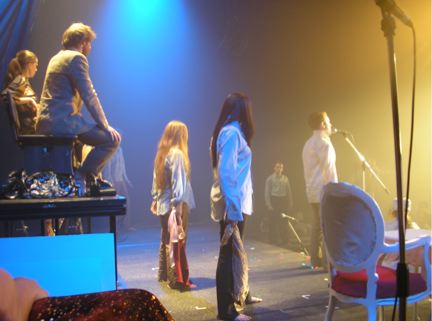
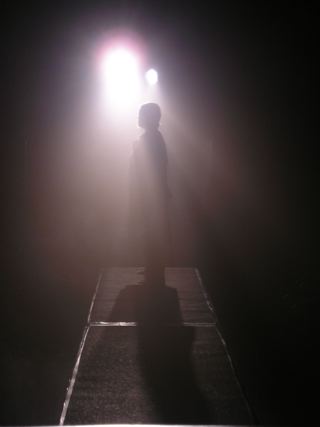
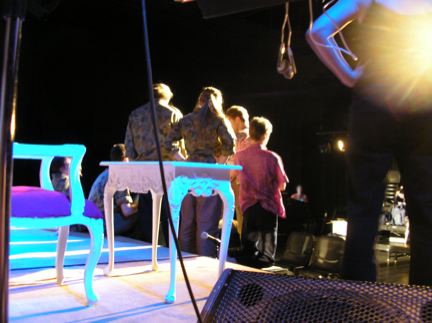
Over the past couple of months I've been writing music for an experimental theatre work called Chicago Chicago, written by Australian John Romiril, directed by Peter Dunn, and performed by the second year acting students at AIT Tafe. The script was written in 1968, and is a satire on the American way of life - with all its foolish granduer, malevolence and decaying culture condensed in 20 disperate though inter-connected scenes.

A presidential candidate is the central character, and as the play unfolds he mentally unravels in his apartment where he is visited by a host of demented characters and a reccuring woman who takes on a series of guises. The subject matter of the play has numerous unnerving parallels with today's global culture of fear, and the actors performances are pushed to absurb extremes - but remain ultimately affecting.

My musical contribution could be best described as a quasi-jazz noise accompaniment - a series of musical themes (mostly acoustic) which introduced each scene with Ruth Buttery on vocals. During each scene I would either play understated jazz/blues motifs on my acoustic guitar, or treat my electric guitar with a socket wrench, bulldog clip, lap slide and my bare fists. The electric guitar wasn't so much played as guitar, rather as an industrial music box - using the webs of feedback and mauled strings to articulate the action on the stage.

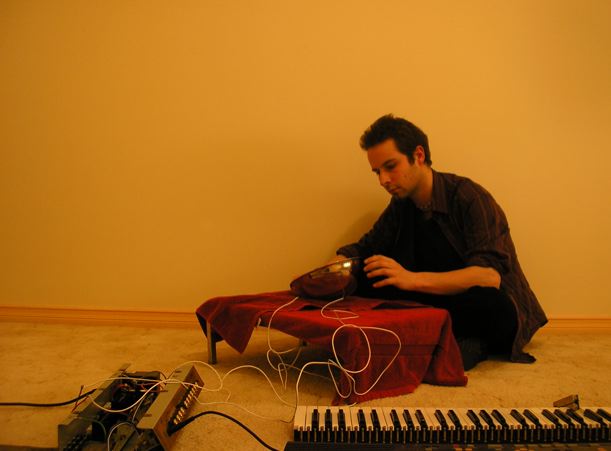
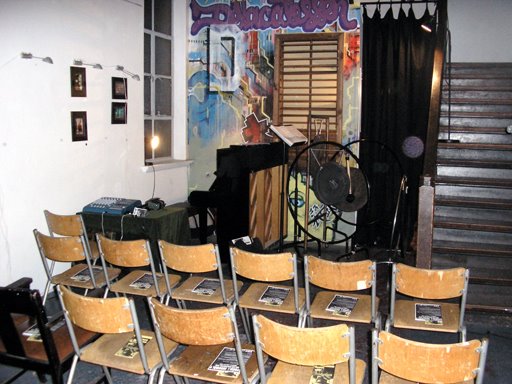
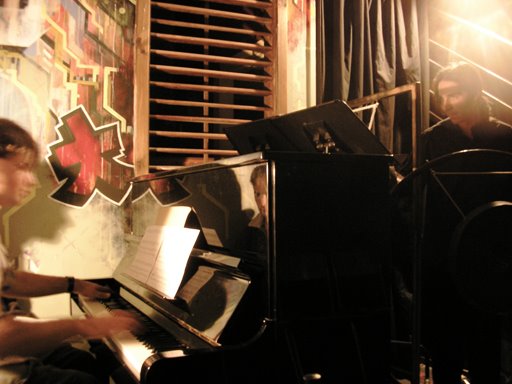
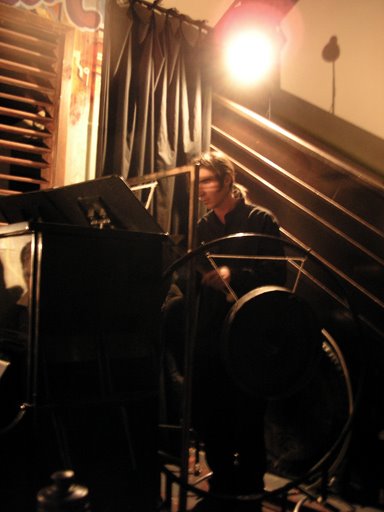
Once I get get hold of a recording taken from the last and most chaotic performance on Saturday I'll post some excerpts for you to hear. In the meantime here are some photos I took:

September 16, 2006

[16.9.06] Directives

I am sitting in my girlfriend's room posting a blog to pass the time. A few things have happened during the week - it has been very busy with rehearsals for a theatre work I am writing music for, and the usual rigmarole of work and finishing my Masters proposal off. One thing has become very clear with regard to the latter, once the proposal is finished (sometine today - one week overdue) I will be leaving Uni and the research for awhile. The reasons for this move stem from being overrun with extra-curricular work, and a need to cut myself free from academia and pursue my ideas and projects with a little more freedom. This might sound a bit dramatic but if you are a student studying arts/humanities at Adelaide University considering doing post-grad in the future, don't do it unless you have yourself finacially backed (i.e. with a Scholarship,etc.) Because the powers that be will not give you any money unless you subscribe to comprimising your art to fit into their niche. It's an ugly old place, and I'm glad I'm getting out with my sanity and interests intact. Still, it could have all changed when (or if) I ever return to Adelaide Uni, then again (let us be realistic) given the direction that all University's are heading - towards absolute commericial interest - people like myself might be making the right choice to leave before we get removed by force. That is a bit dramatic.

There is a better future beyond concrete towers of academia and the city of quartz.

September 08, 2006

[8.9.07] Water, Materials & Sound (II)

A few days ago I spent some time extending my explorations of visualising sound through water by introducing some additional materials. Primarily my intention was to create a process where I would by able to imprint sound waves onto a surface, I came up with the following series of methods.

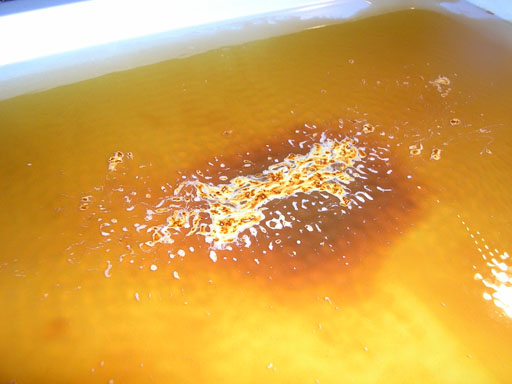
1. Water, paper, instant coffee.

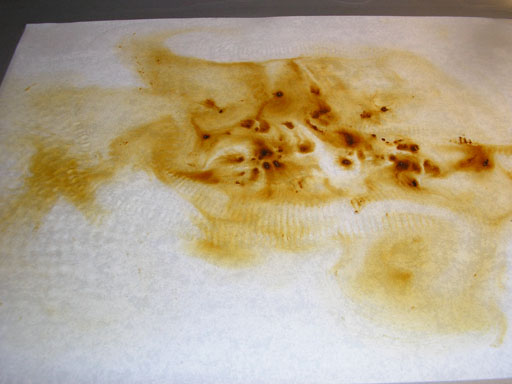
A piece of paper is immersed in a very shallow amount of water, as the metal surface vibrates and makes the sound waves visible on the surface of the water, grains of instant coffee are dropped in the centre of the paper. A low sine wave frequency of 65.4 Hz (i.e C2) was used to resonate the surface of the tray, only a small amount of volume was required to make the waves visible.


As you can see by the image (above), it is a little hard to tell whether the sound waves are affecting the movement of the dissolving coffee grains. Paper was used with the intention of allowing the coffee to stain its surface, in effect 'imprinting' sound and giving it some kind of permanence.

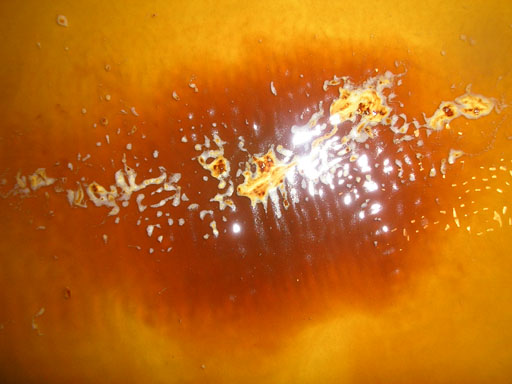
2. Water, instant coffee.

Similar method, though no paper used this time, just the shallow water and the coffee grains. The same sine wave frequency of 65.4 Hz was used.

Again, difficult do really determine the waves influence of the dissolving coffee grains, but visually it was quite interesting.


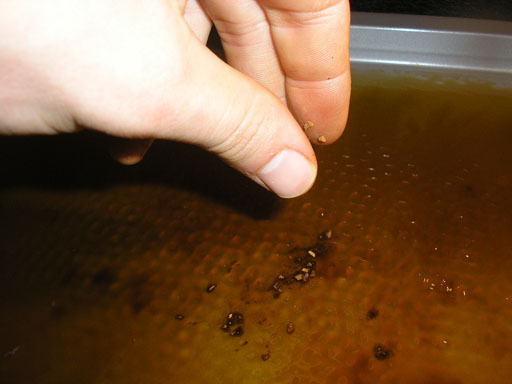
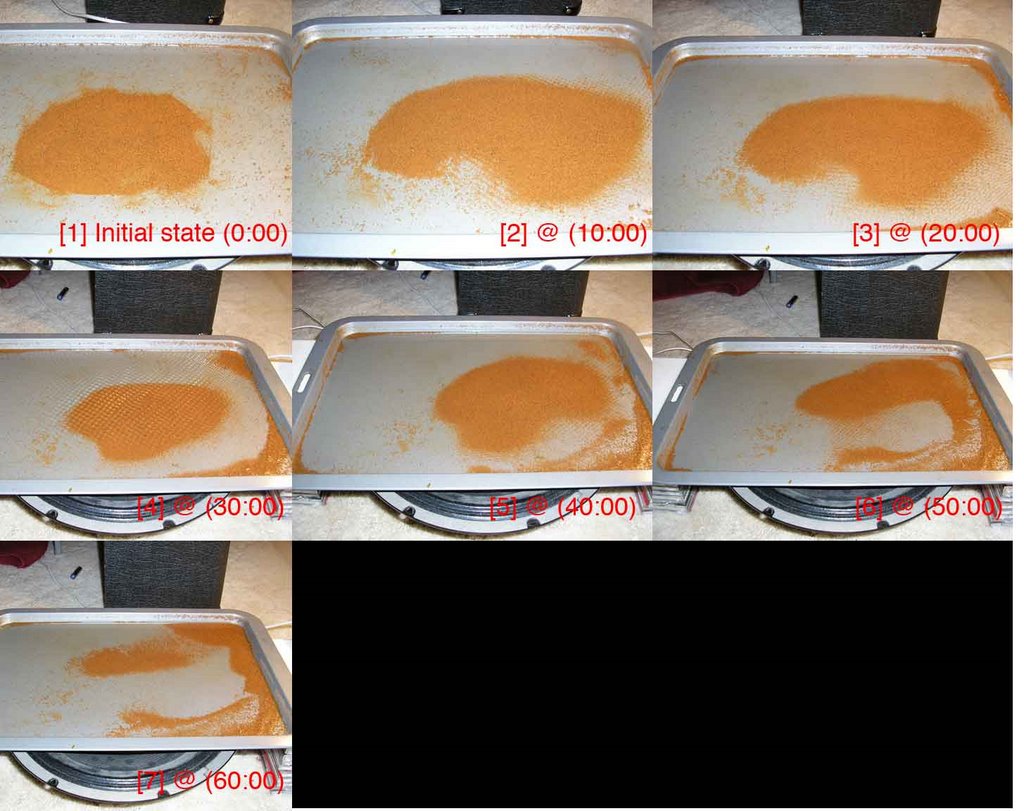
3. Water, ground nutmeg.

Finally, some success. Nutmeg grains were immersed in the shallow water, and one the had settled on the surface of the tray, the C2 tone was played and left for one hour. The images below show the formation state in ten minute intervals. To observe the details of the process I uggest you click on the image below to enlarge it. (don't panic it's 'websafe')


I would say that my experiments in this field have been exhausted for the time being. I will revisit them when I can find a means of applying them in an appropriate installation and/or performance context.

August 29, 2006

[29.08.06] Visualising sound with water and light

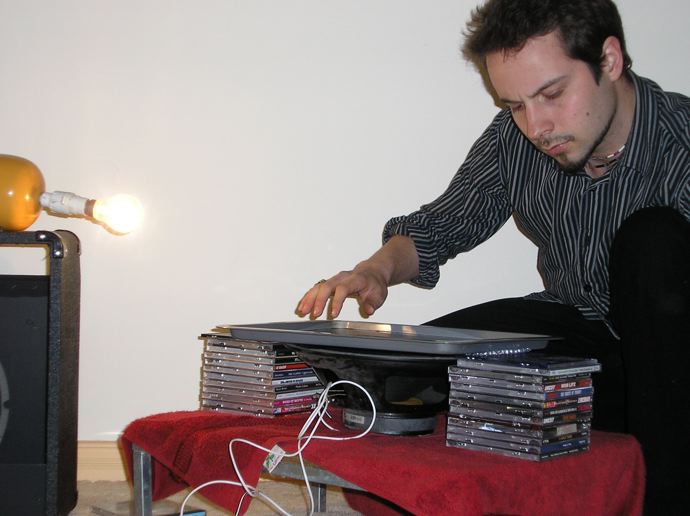
This afternoon I experimented with making the propagation of a sine wave visible using a shallow amount of water in a cooking tray and a directional light source to capture the wave's movement. As with the bowl piece, I've been using my Marshall amplifier to drive the sine wave, the amp and speaker have been removed from the speaker box as this makes things more convenient. The thing about a cooking tray is that it (at a specific set of frequencies) it resonates quite violently, so not a great deal of volume is required for this phenomena to take effect. This is good as I really want the sine waves to be in the background as much as possible. Though they are part of acknowledging the intention behind this process (sound and vision), the sine waves shouldn't necessarily be the centre of attention, the beauty lies in its interaction with the metal tray, the water and the refracted light. I am thinking of incorporating this into an installation - a darkened space, with four or five of these trays (of various sizes), listeners would be given hand held torches and go around to each of the trays reflecting light off the moving surfaces of the water. The sine waves could also move in cents of frequency (gliss) as this would cause the waves to move and change shape and formation. I'll write more on this soon...


With the setup of speaker, water tray and directional light (amp and oscillator out of shot.) What I'm doing here is trying to move the waves around manually.


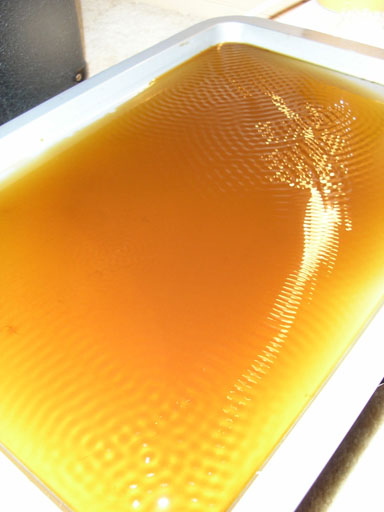
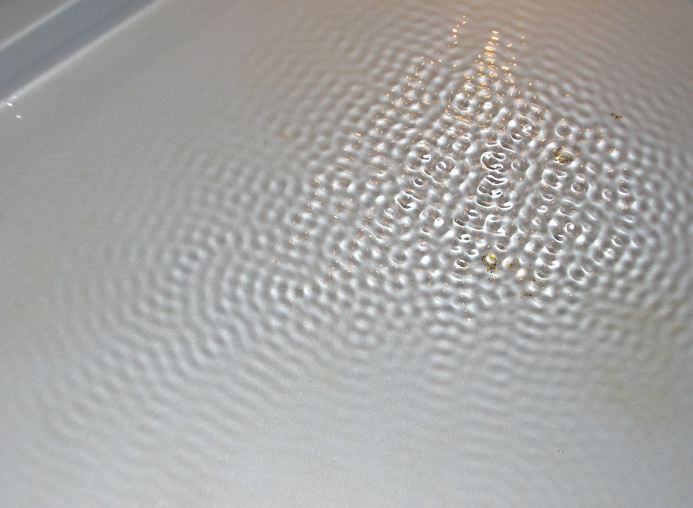
Example one: A low frequency resonance (note large bandwidth). The metal tray has many resonant nodes, the complicated formation is due to the waves reflecting off the edges and corners. It would be interesting to see a more pure representation of a single spherical formation - though this is proving difficult to acheive.


Example 2: A much more elaborate formation at a higher frequency with a shallower amount of water. A blue bulb was being used at the stage.

August 22, 2006

[22.8.06] The Past 2 Weeks

Here's a summary:

[22.8.06] CCSP Research Proposal Presentation

This was a presentation that didn't go badly, but didn't go well either. For a start I was grappling with a change in the direction of the topic (which happened two weeks ago), and had been rushing to put together something plausible. Secondly, I forgot my copy of Lucier's I Am Sitting In A Room, and was forced to explain the process with the audio (which equates to disaster). Finally, I ran out of time and was unable to present the last two components of my research methodology, as well as demonstrate a new work, Songs and Paintings for (a) Metal Bowl(s) [more on this work below]. There were some constructive comments at the end, and for some reason they weren't directed at the apparent holes in my topic at present, then again maybe they were being polite.

[19-20.8.06] Songs and Paintings for (a) Metal Bowl(s).

This is the work that was going to be demonstrated at my CCSP proposal, oh well - perhaps some other time. Here's a technical description:

This a work called Songs and Paintings of (a) Metal Bowl(s). It is a work for a sine wave generator and a metal bowl with a shallow amount of water in it. Attached to the outer base of the bowl is a piezo speaker allowing direct contact with the metal surface. A sine wave which corresponds with the resonant frequency of the metal bowl is played through the speaker thus causing its physical state to vibrate and sound. Because the contact speaker is attached at the centre of the bowl’s base, this creates what is called a node – that is where the amplitude of a wave in a given medium has a value of zero. By tilting the bowl, the water’s edge changes it’s coverage of the bowls base, enabling primary and corresponding harmonic nodes of the bowl to become amplified. The loudest sound appears when the the water’s edge is exactly halfway across the diameter of the bowls base, this represents the first harmonic of the bowl, similar in the way that if you play the 12th fret harmonic of a guitar (exactly halfway along the strings length).

There is no performance process decided upon at present, though two possible outcomes have arisen through a careful examination of the system and it’s relative phenomena.

The first possibility is to allow a performer to explore the sonic potentialities of the bowl by thoughtfully employing different playing techniques, such as tilting the bowl to sweep through its harmonic range. The performer may also sing or project sounds into the bowl, thus causing beating patterns and the amplification of certain waves. Performance could also involve more than one bowl, of different sizes, resulting in an array of contrasting resonances.
(See image below.)


The second possibility is to put the bowl at a fixed position so that the first (and strongest harmonic) of the bowl is sounded. And due to the strong amplitude of the resonant wave - patterns relative to the propagation of the sound wave across the base of the bowl become visible on the surface of the water. With the benefit of a directional light source to refract the wave phenomena, these patterns become more visible and attractive. These patterns could be altered by lowering and raising the frequency of the resonant sine wave by slight degrees – in this case a pitch shifter is ideal for this. For an audience to observe the wave patterns, a video camera could be setup to project the process on a video screen.

[18.8.06] Raoul Valentine plays at the Academy Awards.

A more lighthearted moment came at the Helpmann Academy Awards where I appeared in the rare guise of Raoul Valentine. The girls backstage did a lovely job with the make up as Raoul demanded they make him look respectable. As a cross between Jack Sparrow and Liberace, Raoal sung Tom Waits' 'Temptation' and Leonard Cohen's 'I'm Your Man'. Doing his filthy duty, Raoul took his award and receded like an unforgiving hairline - INTO THE NIGHT.
August 10, 2006

[10.8.06] Life After Laptop

It has been awhile since I last posted and there is a legitimate reason, my laptop fell into a strange coma last Saturday night and I think it is going to cost me a fair bit to fix. I don't have a fair bit at my disposal at the moment, so that means it is out of action for awhile - So that's pretty legit - the convenience and laziness of wireless internet has prevented me from posting blogs at my usual furious rate. The laptop's demise was a traumatic affair, though I managed to save all of my data. Now I'm stuck with my old G4 box ... oh well - it could be worse.

August 01, 2006

[1.8.06] Research Progress: Ecotone

Today I didn't have much time to experiement with sine waves, so instead my thought turned to working on an idea for an installation instead. Working under the title of Ecotone, I am interested in constructing an environment where the physical and acoustical properties of resonant objects are effected by variations in temperature and humidity. The term Ecotone relates to a point of transition between two ecological systems, for example think of a rural environment merging into an urban one.

I will set up a series of objects, or vessels if you will, (vases, glasses, cooking trays, etc.) and attach contact mics inside them - one to receive an input signal and the other for the output siganl (a feedback signal will provide sound). Then once the feedback signal (or threshold) is audible and consistent, I will set up an automated temperature/humidity control and let the process and the room do the work. It is going to be a lot of trial and error, but at least this an official point of departure.

July 31, 2006

[31.7.06] Research Progress: Sine Tests

Today I spent most of the day in my room atop the Shultz building on level 9 reading books on Alvin Lucier and playing with sine waves. Recently I've constructed a portable loudspeaker frame built out of a guitar stand, some twine and bubblewrap. The loudspeaker is the surviving Kenwood beauty from the June sine tone test disaster (see archive.) The frame is a handy little apparatus that allows me to direct sound towards things.

I.

In my room I did a couple of experiments with feedback modulation of a fundamental sine wave - a process of fixing a microphone close to a speaker cone, raising the mic input to the feedback threshold and tweaking the EQ on a mixer. Through the speaker I played a sequence of single sine waves, starting with 110Hz then shifting 0.5Hz every thirty seconds. As it played back I wasn't necessarily interested in tweaking the EQ all over the place, I was more content with setting the EQ to a fixed position (so that feedback signal was consistent) and letting the periodic shift of frequency of the sine waves do the modulating. There were some very interesting results - pulse patterns and harmonics shifted in and out of phase with each other as the fundemental frequency shifted away from the EQ presets. I'll be doing more tests tomorrow as there are some acoustic phenomena that remain unclear (the room's resonant frequency may be playing a part as well - I'm not sure.)

II.

I then moved my gear out into the Shultz staircase and played some sine and square waves into the space. It was really just a bit of fooling around. In such a resonant area as a stairwell, high-ish frequencies such as 880 - 1200 Hz are suited best as they are reasonably directional and capable of being reflected through the staircase, opposed to a lower frequency which just oozes all over the place. Tomorrow I may explore the prospect of using two sine waves, seperated by a couple of floors and tuned slightly apart from each other - say 1100 and 1123 Hz.

III.

I took the latter idea into the EMU performance space next, pairing a fundamental frequency of 880 Hz with a modulating frequency of 881Hz which shifts by 1 Hz every thirty seconds. As these waves were played into the space, I went over to the Steinway piano and played A5, B5 and C6 notes, observing how the richness of the piano's harmonics caused the sine waves to heterodyne and spin off in various directions. This is a method explored by Alvin Lucier in many of his works, specifically Still and Moving Lines In Families Of Hyperbolas (1973-4) and Wind Shadows (1994).

So, an exiciting day of practical activity, more tomorrow (and some pictures.)

July 28, 2006

[27.7.06] Tyndall Assembly 8

Last night's Tyndall Assembly concert was by far one of the most satisfying programmes thus far, though on the other hand it was a depressing crowd attendance pulling barely half a dozen patrons. This was a great disapointment for me as the performing artists put such a great deal of time and commitment into their works for this concert. Both performances were sublime, articulate and original - by local composers, artists and performers - I urge you to make it to a concert in the future when you have the chance!


The revised staging set-up (other way round)


Andrew Georg (piano) performing his Music For Gongs and Piano with Paul Backman on percussion.


Paul Backman (percussion)


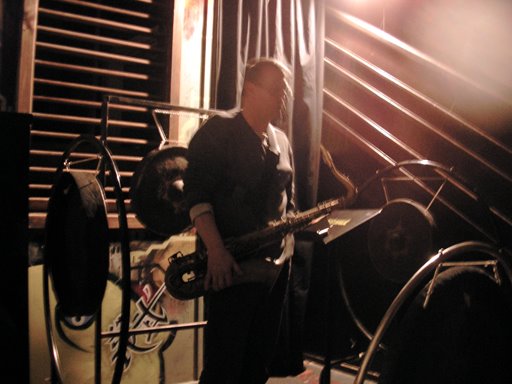
Derek Pascoe introduces 365 Days for solo saxophone.


Derek Pascoe performs 365 Days.

The next Tyndall Assembly dates are: 24th and 31st August

[26.7.06] FAD Bar gig


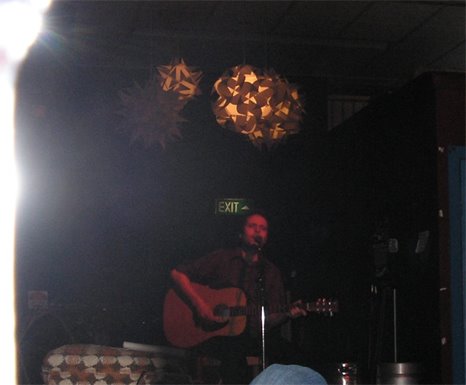
A tiny crowd came and saw my two-hour set on Wednesday night, it wasn't a complete loss though as it gave me the chance to play some more recent material.

Here's the setlist:

1. Stopframe
2. Cherry Blossom Blues
3. To The Stars
4. Discipline
5. She'll Come Around
6. Almost Everything
7. Secret Meeting [The National]
8. So Little In Between
9. Age Of Abstraction
10. Facing The Sun
11. Rendezvous
12. Rare Sensation
13. Broken Piano
14. Losing Heart
15. Mona Lisa [Grant Lee Phillips]
16. Fever Dream
17. Solotaire
18. Fool That I Am
19. Valentine's Day / Raspberry Beret [Prince]
20. Love Minus Zero (No Limit) [Bob Dylan] ~ for Edie.P

intrepid visitors since 25/1/08